
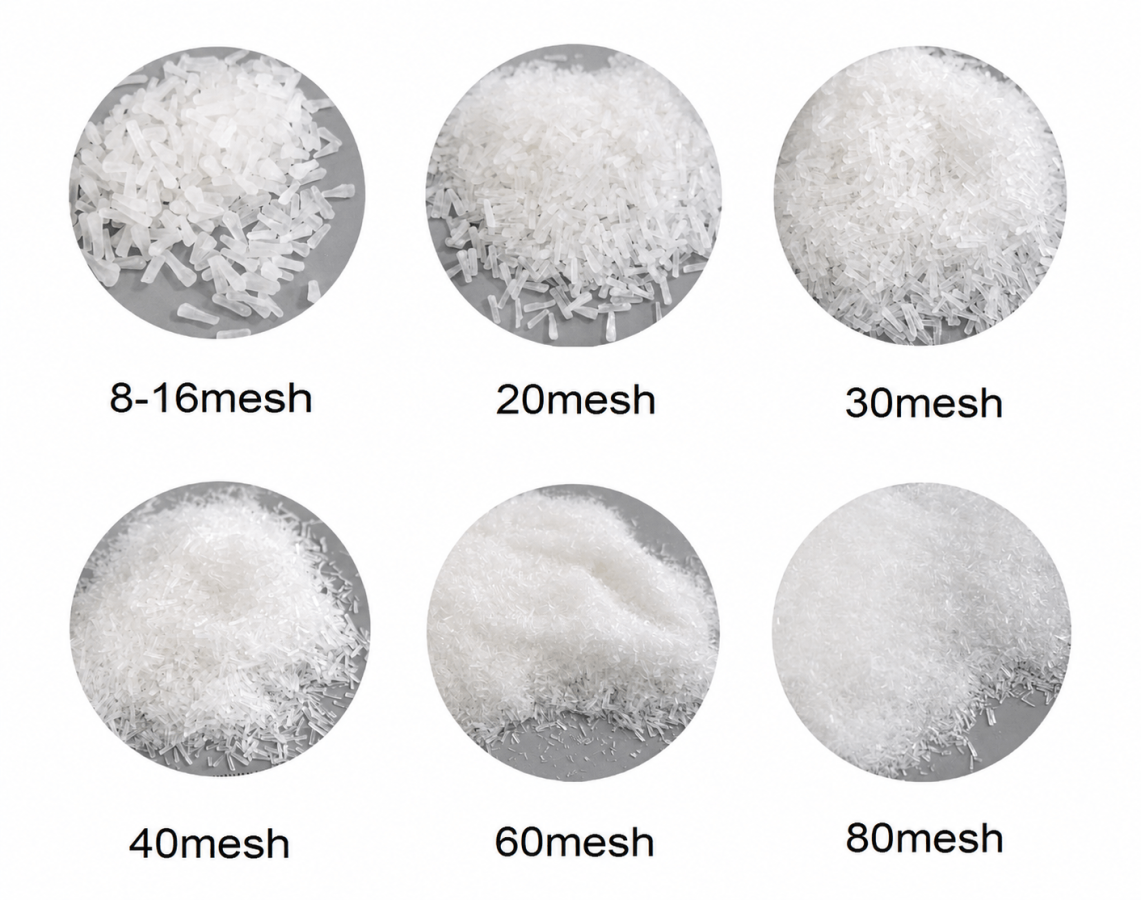
You may have noticed that MSG is available in different mesh sizes, such as fine, medium and coarse crystals. Why are there different sizes, and how are they made?
Why Does MSG Have Different Mesh Sizes?
Different applications require different MSG crystal sizes.
For example, fine MSG can dissolve more quickly and is commonly used in seasoning blends and instant food products. Larger MSG crystals may be preferred for certain food processing or packaging applications.
The suitable mesh size depends on the customer’s product formulation, processing method and market requirements.
How Are Different MSG Sizes Made?
MSG crystals are separated and classified according to their size during the production process.
After crystallization and drying, the crystals are processed through screening and grading equipment. Different screens separate the crystals into different size ranges, resulting in different mesh specifications.
Why Can Mesh Size Vary Slightly Between Batches?
Even when the same mesh specification is required, it is normal for there to be small variations in crystal size between different production batches.
This is because MSG is a crystalline product, and factors such as:
- Crystallization conditions
- Drying conditions
- Screening efficiency
- Crystal shape
can cause slight differences in the final particle-size distribution.
Therefore, a mesh specification represents a controlled size range, rather than every single crystal being exactly the same size.
Choosing the Right MSG Mesh Size
The right MSG mesh size should be selected according to the customer’s application, processing requirements and target market.
We can supply MSG with different crystal sizes and customize the product according to specific purity, mesh size and packaging requirements.
Different applications. Different mesh sizes. The right specification makes a difference.